Same room. Same bulb wattage. Different light.
CRI is the spec most lighting brands hope you never ask about.
A scale to 100. Most LEDs stop at 80.
CRI — Colour Rendering Index — measures how faithfully a light source shows colour compared with natural light, on a scale to 100. Sunlight scores 100. A candle scores close to 100. Most LED lighting sold in Singapore scores around 80.
At Ra80, roughly a fifth of colour fidelity is gone — and it is not lost evenly. Reds fade first. Wood turns grey-brown, leather goes flat, skin looks tired, food looks less fresh. The room is bright, but everything in it is slightly wrong.
Nothing in the room changed. Only the light did.
See it on the same room.
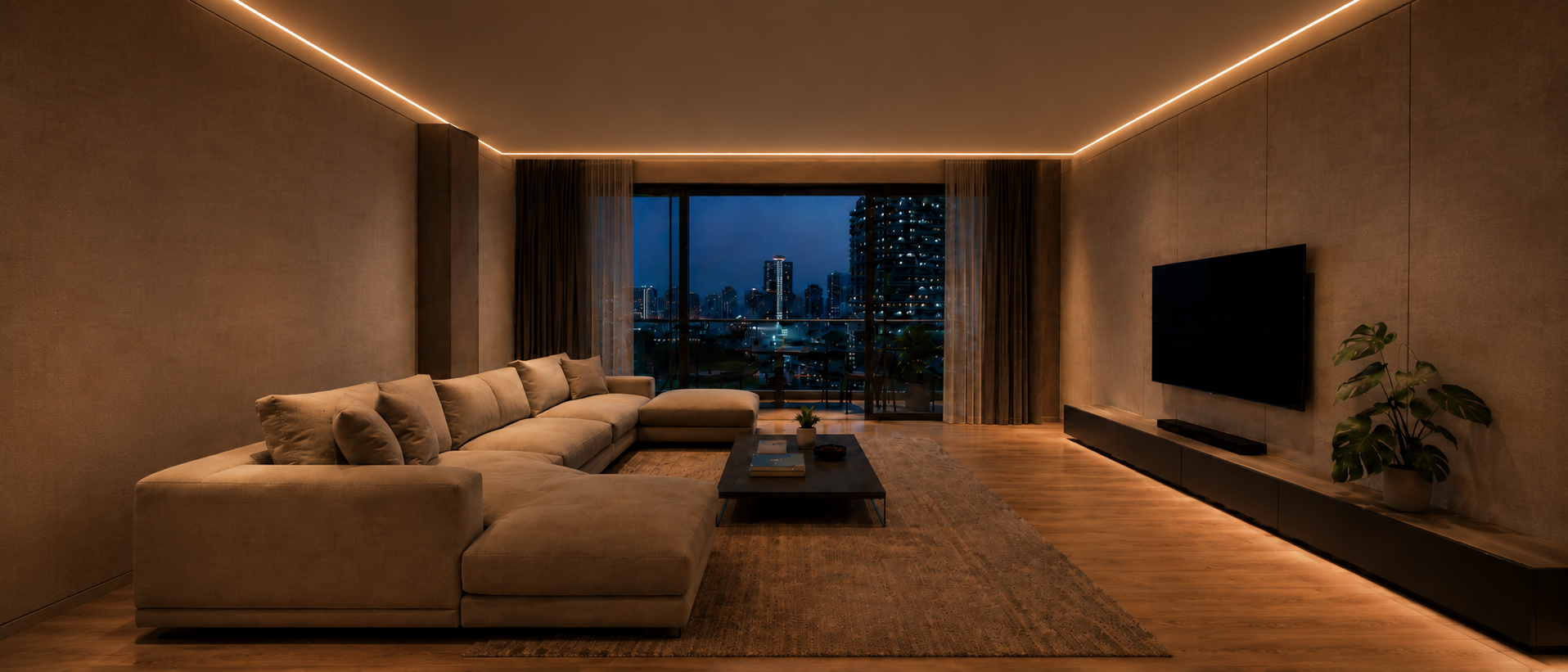
Illustration of the effect. Colour rendering varies by object and light source.
R9: the one nobody publishes.
Here is the part most brands leave out. The general CRI score (Ra) averages only eight pastel test colours — none of them a saturated red. Red rendering is measured separately, as R9. A bulb can score Ra80 while its R9 sits near zero.
Red matters more than any other colour at home. It is in skin tones, timber, leather, brick, tomatoes, a glass of wine. Low R9 is why food photographs badly in some kitchens and why faces look washed out in some mirrors.
Every KAYVA product is Ra95+ with R9 above 50, and both numbers are backed by an independent test report. If we cannot verify a spec, we do not print it.
Ra95+ is the standard museums and galleries specify. Your home holds the things you chose — it deserves the same standard.
High CRI costs lumens.
A Ra95+ bulb produces less raw brightness than a Ra80 bulb of the same wattage, because rendering colour faithfully takes energy that would otherwise go to raw output. We think the trade is worth making — you renovated for colour and texture, not for lux readings. But you should know it exists.
The Range